Running into the Year of the Horse
Francesca Giacco
I end and begin every year by reading the same poem – “i am running into a new year” by Lucille Clifton. It starts with hope and momentum, as the title suggests, but the past proves just as powerful. Clifton describes it as a strong wind that whips her hair back, strong like old promises – broken and kept. She writes:
it will be hard to let go
of what i said to myself
about myself
when i was sixteen and
twenty-six and thirty-six
even thirty-six but
i am running into a new year
and i beg what i love and
i leave to forgive me
I’ve wondered what makes this poem a touchstone for me, and have settled on its optimism. No matter how often we fall short or disappoint ourselves, we can leave failure behind, let it go as we decide to run into something new. I’ve found there’s freedom in what’s been abandoned, sometimes more than what I’m running, even galloping, towards.
Last month, a friend sent me an Instagram post describing the Year of the Horse, the start of which was then still a few weeks away.
"The Year of the Horse signifies running toward energy, movement, and enthusiasm," it read, foretelling this year would push us to "ask questions of the world, with an abundant mind."
It was all a bit obvious, as the zodiac can be. It’s no surprise that horses conjure motion, strength, independence. But to me, they’ve always meant much more – freedom and responsibility, trust and restlessness, danger and love.
I think that could be why running into the Year of the Horse feels different. Clifton’s poem puts a premium on the new, on progress, on loving our old selves even as we cast them off. This year seems poised to remind me of what I’ve almost forgotten.
I rode horses for my entire childhood. When I wasn't riding, I was anticipating and imagining the next time I would, the speeds we would reach, the heights we would jump. When I wasn’t on a horse, I was caring for them. I scrubbed mane and tail shampoo into their coats and slowly rinsed it off, softened leather bridles with saddle soap. To ride a horse, you had to tack it yourself. I learned to ease the bit into the mouth gently, tighten the girth gradually, with attention and respect. When I wasn’t at the barn, I longed to be, to walk quietly past the stalls, hear their low breathing, smell their warmth, be greeted with perked ears, calm eyes, the sense I was being assessed on a deeper level and accepted as I was.
A lot of young girls love horses, and it’s not hard to see why. Riding a horse has the whisper of freedom, a connection with a beautiful animal that, even when tamed, has the potential to be wild. To be in sync with that kind of power, as a girl particularly, is narcotic.
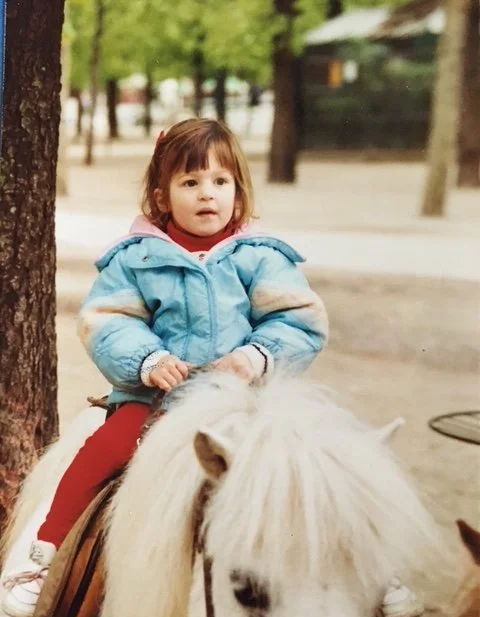
I loved horses for their power, too. But despite all that strength, horses are vulnerable, tied to who they decide to trust. And winning their trust made me fearless. For those years, when I was on a horse, there was, to me, nothing we couldn’t try to do together. I felt instinctually protected, powerful, unafraid.
One of the horses I loved most had a bad reputation. He was unpredictable, stubborn, and such a deep brown he looked almost blue, which became my nickname for him. Every time he took my direction or anticipated what I needed was a fleeting confirmation of something I hoped was true: that I was capable, that I could do difficult things. And I did. The wind Clifton describes as the old years blowing her hair back, I felt it, at eight, nine, and ten, before I was old enough to understand what it was: a part of myself that I would, for whatever reason, try to leave behind. I sensed the acceleration beneath me, the rush of wanting to go faster and feeling it happen.
Any control I had was an illusion and I knew it. Different horses threw me countless times, onto the sandy or hard ground. Once I was dragged by one leg for ten or twenty feet when the rubber band in one stirrup refused to break. It was never the horse’s fault. I always got back up and on immediately, without hesitation.
I’ve seen this reflected back at me over the years, seen children skiing or surfing with abandon, the liberty that comes from the total absence of fear.
Most people who’ve met me as an adult, especially in the last few years, might describe me as rational, maybe even risk averse. Experience has forced that caution on me. But I do remember that girl. She hasn’t faded, at least not entirely. Somewhere in me, ‘she’ still wants to go faster, jump higher, see what will happen when she does.
I stopped riding in high school. It was an unconscious decision, a gradual dimming of a light, in the way things that matter can slowly disappear without you noticing. My excuse was moving to a new state, starting a new school, but that’s not the real reason. Fear had started to creep in, as it had in so many other areas of my life. And nothing, not even the way I felt on a horse, was uncomplicated anymore.
Last year, as fall turned into winter, I met a family friend for tea at the Pierre. I’ve admired her for decades, hadn’t seen her in ages.
We met soon after the move that ultimately put an end to my riding. I was 13, unsure of almost everything, and in desperate need of something, anything, familiar. She was a talented rider with a beautiful farm in the country, and she made time for me. I rode with her through fields, clearing crumbling stone walls on her gentlest horse, one who knew the wooded trails instinctively. The joy it gave me, at a difficult time, was precious.
In the hotel bar that afternoon, we drank cup after cup of strong Earl Grey and talked about life, travel, and, of course, her horses.
“Did you know horses can remember heartbeats? They listen to the rhythm of your breathing, the sound of the blood in your veins,” she told me. “They can recognise you by it before they even see you.”
I told her that being around horses made me feel like myself, which was true. And I said I missed riding, which wasn’t, not fully. I hadn’t let myself acknowledge that loss, let alone mourn it.
“You really should start again,” she said. “I think it would make you happier than you realise.”
I looked through the window behind her at the barely light sky over Central Park, with its bridle paths, and thought,
maybe
and that’s enough, for now.